|
In
This Issue
• Magnetic Biosensors
• Amplifier / Filters for Magnetic Sensors
• Non-Invasive Hemoglobin Detection
Magnetic
Biosensors
With best-in-class sensitivity
and noise, NVE is the leading provider of biosensor elements for academic research
and commercial applications, including lab-on-a-chip, exosome detection, environmental
monitoring, and food safety.
Some older systems use NVE GMR sensors, but newer TMR sensors such as the ALT021-10E
can detect microtesla to nanotesla-scale fields, allowing them to detect the magnetism
of superparamagnetic nanoparticles (SPMNPs) associated with molecular biological
targets. Detection of femtomolar protein concentrations has been demonstrated.
Typical Systems
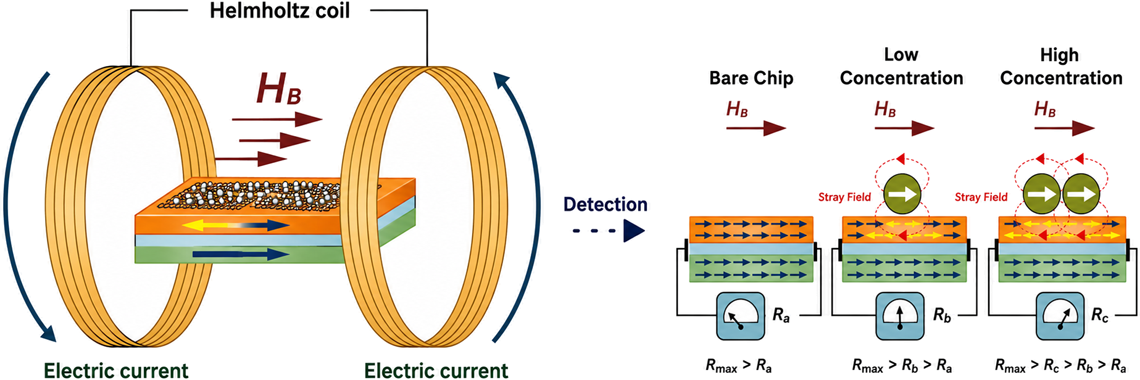
The figure above shows a typical system.
Magnetic beads act as labels attached to the target biomolecule. A sample containing
aggregated beads is located near a GMR or TMR sensor. The sample is exposed to
a magnetic field, Hb, generated by Helmholtz coils. Stray fields from the beads
increase the field at the sensor, so the sensor output indicates the relative
concentration of beads and therefore the concentration of the target biomolecule.
Breakout Boards
The 0.8 x 0.4 inch
(21 x 10 mm) ALT-Series breakout
boards have pre-soldered sensors, standard 0.1" (2.54 mm)
headers, and 1 mm pitch card-edge connectors for easy prototyping.
| |
 |
Amplifier Board
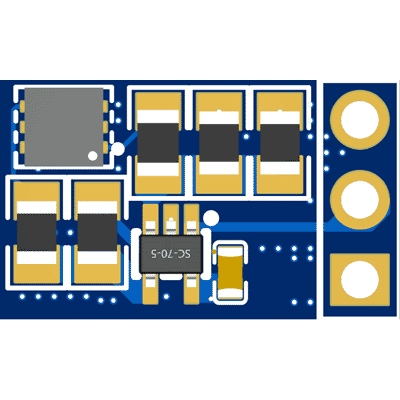
We also offer an evaluation
board with a sensor plus amplifier circuitry. The board provides a 2.5 V/V/mT
single-ended linear output, and can be powered by a 0.9- to 7-volt supply or battery.
New Products Coming
Watch this space for even smaller and more sensitive sensors coming soon.
References
Sensitive
albumin detection method using an MTJ-based transducer
[ALT025] with
a biosynthesized magnetic label at a low bias magnetic field
Sensors and Actuators A: Physical, June 1, 2026.
Eco-friendly
magnetic ferrofluids nanotag for giant magnetoresistance chip-based biosensor
[AAL024]
J Mater Sci: Mater Electron, 37, 323, Feb. 6, 2026.
Ultra
high sensitive magnetic measurement system based on Lock-in amplifier technique
and giant magnetoresistance sensor [AAH002-02E]
Vietnam Journal of Science and Technology, March 25, 2025.
Enhanced
detection of bovine serum albumin using single- and double-chip [ALT025]
configuration
of tunneling magnetoresistance-based biosensor with green-synthesized magnetite/Ag
nanotag
Microchim Acta, Feb. 11, 2025.
Development
of a Reliable Assay of Eco-friendly Fe3O4Ag Nanocomposite-Based Giant Magnetoresistance
Sensor [AAL024-10E]
J. Electrochemical Society, Nov., 2024.
Development
of a Microfluidic Chip System with Giant Magnetoresistance Sensor [AAH002]
for
High-Sensitivity Detection of Magnetic Nanoparticles in Biomedical Applications
Biosensors, August 11, 2023.
New
design of a commercial chip-based GMR sensor [AAL024]
with
magnetite nanoparticles for biosensing applications
Journal of Science: Advanced Materials and Devices, June 2023. |

Sensor
Reference Design Corner |
 Amplifier
/ Filters for Magnetic Sensors Amplifier
/ Filters for Magnetic Sensors
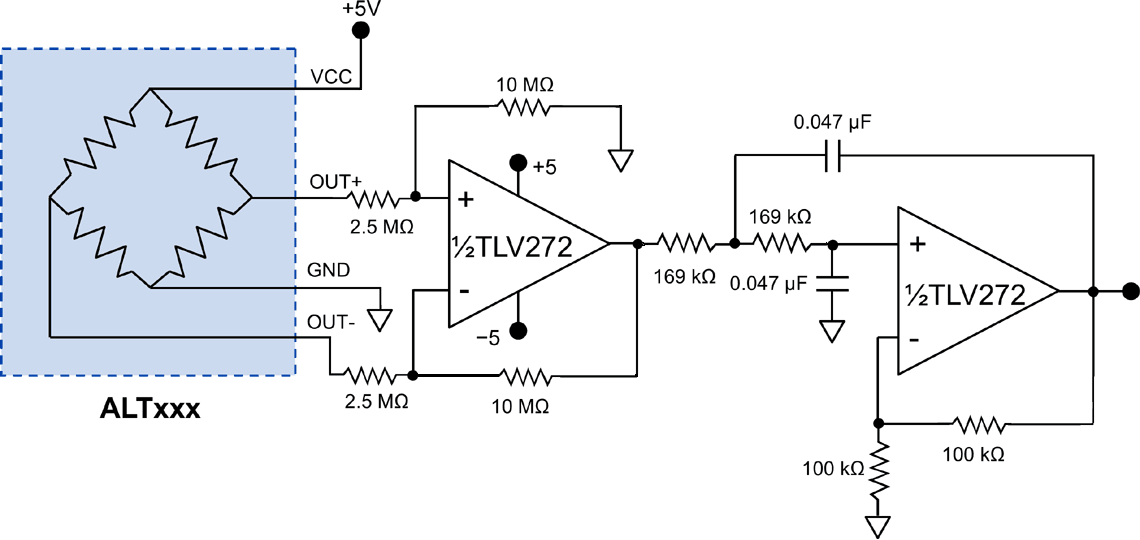
Many applications, such as the biosensors discussed above, require bridge magnetometers
to be buffered, amplified, and filtered. This simple op-amp reference circuit
combines a 4x amplifier and a second-order Sallen-Key low-pass Chebyshev filter
with a 20 Hz cutoff.
The gain of four ensures the op-amp won’t saturate. The Chebyshev filter provides
a sharp frequency cutoff frequency, which can be adjusted depending on the application.
The circuit has jus a few components and produces a single-ended output.
|
|
Non-Invasive Hemoglobin Detection
An independent conference paper
published June 23 describes a non-invasive hemoglobin detection system based on
an NVE AA002-02E high-sensitivity
GMR analog sensor.
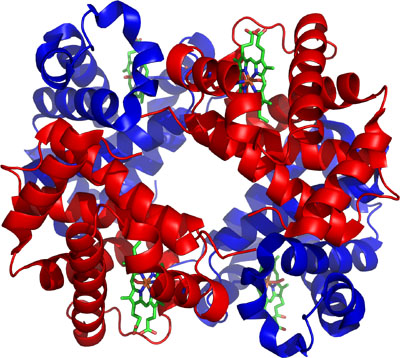
Hemoglobin Structure.
An excerpt:
“...The magnetized hemoglobin is detected using a GMR sensor attached to a U-shaped
probe where the patient’s arm is placed. The sensor output voltage will go through
a signal conditioning circuit consisting of an amplifier and a filter. The voltage
data obtained then processed and compared with the data from clinical testing
using a hemoglobin meter. The result show linear relationship between sensor output
and hemoglobin level with the sensitivity of the sensor obtained at 0.0475 V/(g/dL)
and coefficient of determination (R²) of 0.9663 or 96.63%.”
Abstract »
More independent papers »
 Sensor+Test
Wrap Up Sensor+Test
Wrap Up
Thanks to everyone who visited us at Sensor+Test in Germany recently. Visit our
website or our YouTube Sensor+Test
Playlist for videos of some of the new demos we presented at the show. |
|