|
In
This Issue
• GMR Analog Magnetic Sensors
• Instrumentation Amplifiers
with Magnetic Sensors
Industry-Standard GMR Sensors
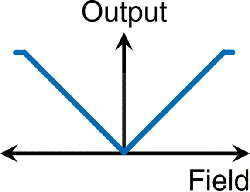 AA00x-Series
analog magnetometer sensors are the industry standard for GMR sensors, with a
best-in-class temperature coefficient of 0.05%/°C. The sensors are configured
as inherently temperature-compensating Wheatstone bridges. AA00x-Series
analog magnetometer sensors are the industry standard for GMR sensors, with a
best-in-class temperature coefficient of 0.05%/°C. The sensors are configured
as inherently temperature-compensating Wheatstone bridges.
The bridge configuration allows easy interface to a variety of electronics or
microprocessors. Their versatility and stability make them an excellent choice
for a variety of analog sensing applications, including position, speed, and current
sensing.
Features include:
• Field ranges from <<0.1 mT to >45 mT
• Ultrasensitive and low-hysteresis versions
• Wheatstone bridge analog outputs
• 0.05%/°C output temperature coefficient (-40
to 125°C)
• 0 to 24 V supply
• DFN6, MSOP8, and SOIC8 packages
A wide range of part types are in
stock and available for immediate delivery.
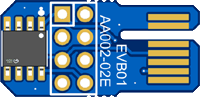 0.8
x 0.4 inch (21 x 10 mm) breakout
boards with easy connections are available for most part types. 0.8
x 0.4 inch (21 x 10 mm) breakout
boards with easy connections are available for most part types.
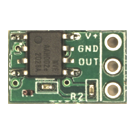
A circuit board with
the high-sensitivity AAH002-02E and an amplifier is also available for a remarkable
sensitivty of 60 V/mT.
Download the datasheet »

|

Sensor
Reference Design Corner |
 Using
Instrumentation Amplifiers with Magnetic Sensors Using
Instrumentation Amplifiers with Magnetic Sensors
Instrumentation amplifiers
are a simple, convenient way to buffer, amplify, and create single-ended outputs
for bridge magnetometers. Although they are more expensive than op amps, instrumentation
amplifiers have a low parts count and deliver good performance.
Boards for instrumentation amplifiers like the low-cost AD623 are widely available
and connect easily to various NVE sensor evaluation boards. |
|
 |
|
 |
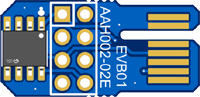
Typical
magnetometer breakout board.
|
|
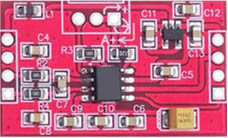
Typical
instrumentation
amplifier board.
|
 An
NVE magnetometer breakout board, such as an AAH002-02E-EVB01
(left) can be used with the amplifier (right). An
NVE magnetometer breakout board, such as an AAH002-02E-EVB01
(left) can be used with the amplifier (right).
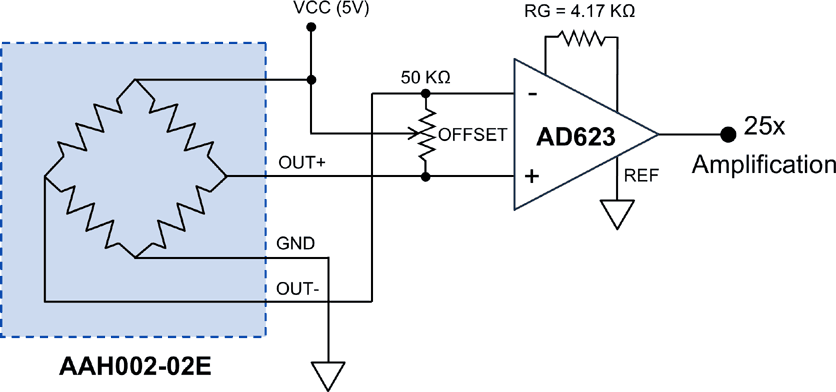
GMR magnetometer maximum outputs are approximately 40 millivolts per volt,
so a gain of 25 provides about one volt per volt, which is rail-to-rail.
A potentiometer can be used to adjust the offset:
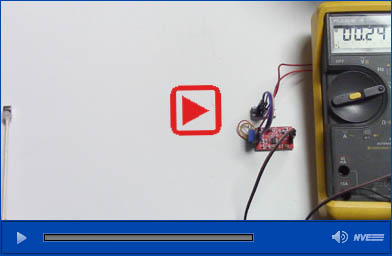
With this ultrasensitive setup, we can easily detect a magnet a foot away. Here's
a live demonstration:
Upcoming Tradeshows
 NVE
will exhibit at MD&M
West February 3-5 in Anaheim, California, booth 773. We'll demonstrate compelling
medical applications of our sensors and isolators. NVE
will exhibit at MD&M
West February 3-5 in Anaheim, California, booth 773. We'll demonstrate compelling
medical applications of our sensors and isolators.
 View our YouTube Medical
Applications Playlist
View our YouTube Medical
Applications Playlist |
|