|
In
This Issue
• NEW
Normally-Closed Magnetic Switch
• Reference Circuit: Using Latches with Magnetic Switch Sensors
• In the News
Normally-Closed
Magnetic Switch
 The
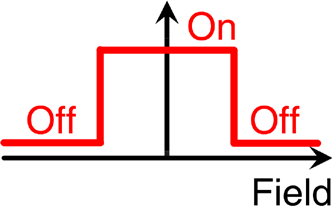
new ADL122NC-14E is a normally closed nanopower magnetic switch, integrating GMR
sensor elements with digital onboard signal processing and duty-cycling electronics.
The open-drain output is normally ON, and turns OFF when a magnetic field is applied.
The switch is extremely low power and ultraminiature. The
new ADL122NC-14E is a normally closed nanopower magnetic switch, integrating GMR
sensor elements with digital onboard signal processing and duty-cycling electronics.
The open-drain output is normally ON, and turns OFF when a magnetic field is applied.
The switch is extremely low power and ultraminiature.
Low Power
 These
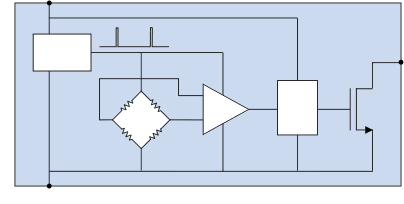
ultralow-power sensors are internally duty-cycled to reduce power consumption.
An integrated latch makes the output continuously available. These
ultralow-power sensors are internally duty-cycled to reduce power consumption.
An integrated latch makes the output continuously available.
Robust Operation
The applied field can be of either polarity, and the operate point is extremely
stable across the supply voltage and the full industrial temperature range. The
open-drain output can sink up to 100 microamps.
Unique Applications
The normally-closed version is useful in several applications. For example, it
can be used to activate electronics when they're removed from a case. It can be
used to activate sealed electronics, such as a single-use medical device, with
an available medical-grade version.
 Key
specifications include: Key
specifications include:
• Omnipolar
• 2.4 to 4.2 V supply voltage
• Power as low as 84 nW
• Full –40 to 125°C temperature range
• Ultraminiature 1.1 x 1.1 mm DFN package
Demonstration
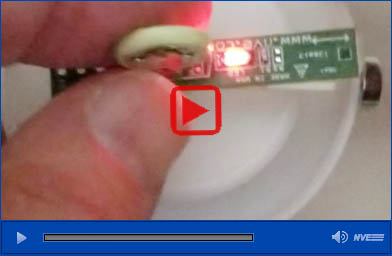
This video shows the operation of this unique new sensor:

Download the
datasheet » |

Reference
Circuit Corner |
 Using
Latches with Magnetic Switch Sensors Using
Latches with Magnetic Switch Sensors
Sometimes we need to activate
limited access, single-use electronics once they're in place. Perhaps a medical
or industrial device. The circuit must be very low power in the quiescent state
so it can sit idle for a long time. Once activated, it needs to supply higher
current.
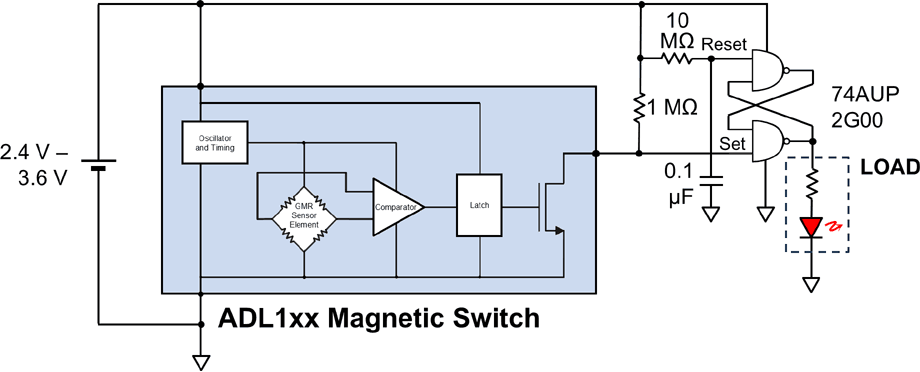
Here's the reference circuit: |
|
The circuit uses a nanopower GMR switch sensor powered by a three-volt lithium
button cell. These sensors are duty-cycled to reduce power and latched to ensure
the output state is correct when the duty cycle is off.
A dual CMOS NAND gate connected as a set-reset flip-flop provides an additional
layer of latching. The flip-flop is reset on power-up, and latched when the sensor
is activated. The load goes on and stays on when the circuit is activated with
a magnet.
An LED is shown as the load, but it could drive any circuitry up to 4 mA
with the gate shown. The activated circuitry could transmit data or perform some
other function. Medical-grade sensors can be used to activate limited access medical
devices.
The sensor draws a maximum of 0.24 µA, and the CMOS gates draw a maximum
of 0.5 µA, so the total quiescent current is less than a microamp,
and a button cell will last for years until the circuit is activated.
Here's a live demonstration:
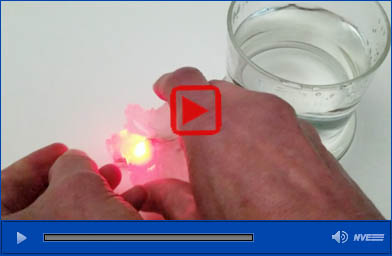
Click here
for more information on the magnetic switch sensors and evaluation boards that
can be used with this circuit.
In
the News
Magnetics
Business and Technology announced the NVE ADT501-10E,
an ultrasensitive, ultralow power, TMR noncontact rotation sensor. |
|