|
In
This Issue
• Wafer-Scale Sensors
• College Students Eventually
Learn
 Wafer-Scale
Sensors Wafer-Scale
Sensors
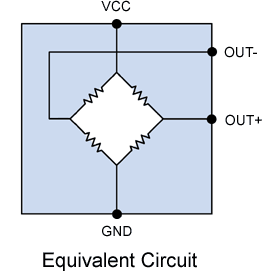
You might have heard a lot about NVE's new, ultraminiature wafer-level
chip-scale package sensors. But sometimes, more really is MORE, so this April 1,
we're introducing our new wafer-scale package sensors.
A Big Difference
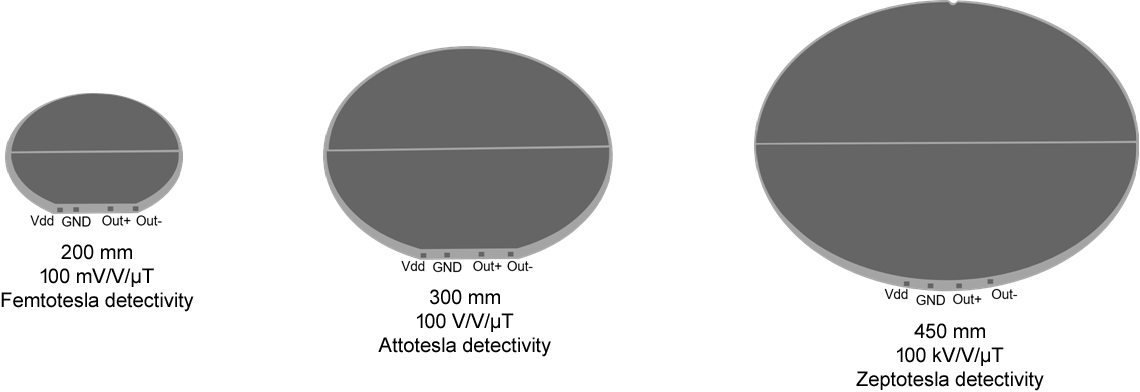
Available in state-of-the-art 450 mm and 300 mm wafers, as well as legacy
200 mm formats, these new sensors are a fully monolithic solution designed
to push the sensitivity of TMR sensors to the final frontier—literally. Each
25-wafer lot ships in a high-protection case with rolling wheels and a recommended
two-person lift procedure.
Go Large
Large packages means large flux concentrators and large TMR junctions, enabling
a solution to effectively upend the market for SQUID and SERF magnetometers. Key
features include:
• Large packages from 200 to 450 mm
• Large sensitivity from 100 mV/V/µT to 100 kV/V/µT
• Large temperature range from -40 to +125°C
• Large prices, because wafers don't come cheap (although neither
do SQUIDs or SERFs)
Sounds Like April Fools' but Isn't
A research group used NVE high-sensitivity sensor
evaluation boards in a study that roughly concluded that college students
will eventually learn something if you keep repeating it. The authors note that
ethical approval was obtained from the Swedish Ethical Review Authority, presumably
since you're allowed to do just about anything to undergraduates. The results
were published in the journal Science
of Learning.
Excerpts:
"Our findings show, for the first time in humans using this protocol, that
learning improves substantially on days 2 and 3."
and most importantly:
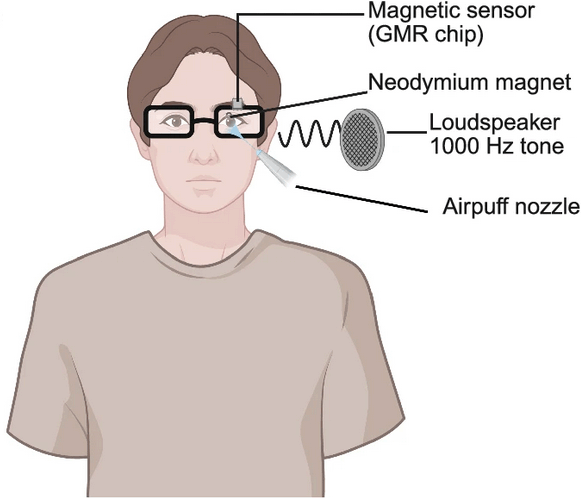
"Participants were equipped with custom-made glasses that had a nozzle for
aiming and delivering the air puff, and a GMR chip (AAH002-02E,
NVE Corporation) attached to the frame of the glasses."
Link to the paper »
|
|
|